

Every time you walk into a bank branch to apply for a loan, the loan officer hands you a seemingly simple EMI figure. But have you ever paused to ask how exactly they calculate it?
Unfortunately, most people blindly accept whatever the bank's system spits out. That is a massive financial mistake. If you know how your Equated Monthly Installment (EMI) is calculated, you gain the power to confidently compare different lenders, spot hidden administrative costs, and potentially save lakhs of rupees over the life of your loan.
In this guide, we will break down the exact mathematics of how an EMI is calculated in India, why you should never rely on bank-provided calculators that harvest your data, and how to use our 100% private tool.
Why You Should Always Calculate Your Own EMI
Banks in India often present EMI figures that bundle processing fees and insurance premiums into the "effective interest rate." By calculating the raw EMI yourself using just the principal, interest rate, and tenure, you establish a solid baseline. Anything the bank quotes above that baseline is something you can question.
Secondly, most loan EMI calculators on banking websites require you to fill out a "lead generation" form before showing you results. They are designed to capture your phone number and sell it to telemarketing agents.
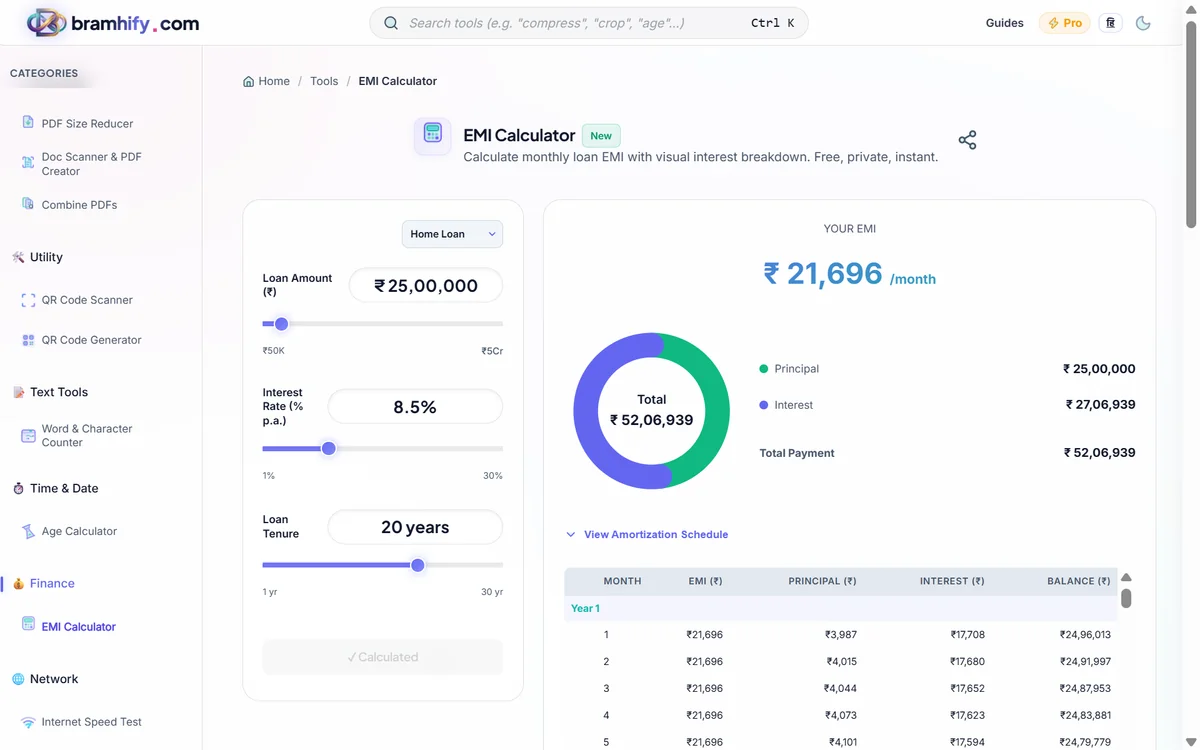
Bramhify's EMI calculator is entirely different. It runs 100% locally in your web browser. You enter your numbers, and you instantly see the results. There is no form to fill, no database saving your financial queries, and absolutely no annoying calls from a loan agent five minutes later.
Try the 100% Private EMI Calculator:

The Mathematical Formula Behind Your EMI
Banks use a universal financial formula to calculate your exact monthly installment:
EMI = P × r × (1 + r)^n ÷ ((1 + r)^n - 1)
P = Principal loan amount
r = Monthly interest rate (annual interest rate ÷ 12 ÷ 100)
n = Total number of monthly installments (years × 12)
A Real-World Example:
Imagine you take a ₹30 lakh home loan at 8.5% for 20 years. - P = 30,00,000 - r = 8.5 ÷ 12 ÷ 100 = 0.007083 - n = 20 × 12 = 240 months
When you plug these numbers in, your exact EMI equals ₹26,035 per month.
The real shock comes when you look at the total amount paid. Over 20 years, you will pay back a total of ₹62.5 lakhs. You borrowed 30 lakhs, but you paid back 62.5 lakhs. That extra ₹32.5 lakh is pure interest going straight to the bank. That number changes dramatically with small changes to the interest rate or tenure.
Step-by-Step: How to Use the Private Calculator
Step 1: Enter the Principal Loan Amount
Tap the "Principal Amount" input field and type the total loan amount in rupees. For a home loan, this is usually the total property value minus whatever down payment you are making from your own savings. For a car loan, it is the on-road price of the vehicle minus your initial down payment.
Step 2: Set the Annual Interest Rate
Enter the annual interest rate that your specific bank is offering you. In India, home loan rates typically fluctuate between 8% to 10.5% depending on macroeconomic factors and your personal CIBIL score. Car loan rates are slightly higher, usually ranging from 7.5% to 12%.
Tap the rate field and type the exact percentage. Remember, even a tiny 0.5% difference in the interest rate can change your monthly EMI by ₹500 to ₹1,000, which can cost you several lakhs extra over a 20-year period.
Step 3: Choose Your Loan Tenure
This is exactly how long you will take to repay the loan, measured in years. Home loans in India commonly run anywhere from 15 to 30 years. Car loans are much shorter, typically running 3 to 7 years.
Slide the interactive tenure slider or type the number directly into the box. Watch the results carefully: extending your tenure by 5 years drops your monthly EMI slightly, making it feel more affordable today, but it massively increases the total lifetime interest you pay to the bank.
Step 4: Instantly Read Your Results
Without pressing any submit buttons, the calculator instantly shows you three critical numbers:
Monthly EMI - the exact amount that will be deducted from your bank account every single month.
Total Interest Payable - the true, extra cost of borrowing this money.
Total Amount Payable - the full repayment figure (your principal amount + the total interest).
If you scroll down further, you will see the Amortization Schedule. This is a detailed, month-by-month breakdown showing exactly how much of each ₹26,035 EMI goes toward paying off the principal versus paying the interest. You will quickly notice that in the early years of the loan, almost your entire payment goes directly toward interest. Only in the later years does the principal balance begin to reduce significantly.
Pro Tips to Lower Your Lifetime EMI Burden
1. Increase your initial down payment. Paying just ₹2 lakh more upfront on a home loan can save you an astonishing ₹8 - 10 lakh in total interest over a 20-year term.
2. Improve your CIBIL score before applying. Banks routinely offer lower promotional rates to prime borrowers with CIBIL scores above 750.
3. Compare different lenders. Run the calculator with multiple rate scenarios. A ₹50 lakh loan at 8.5% versus 9.5% is a difference of roughly ₹85,000 per year, which translates to a staggering ₹17 lakh difference over 20 years.
4. Opt for a shorter tenure. A 15-year loan costs significantly less in total lifetime interest than a 20-year loan. If your salary can handle the larger EMI, the shorter tenure is the mathematically superior choice.
A Strict Note on Financial Privacy
When you calculate loan scenarios on Bramhify, your financial numbers remain entirely on your device. We do not collect your loan amount, interest rate, or any other data. The calculator runs locally using your phone's processor - nothing is sent over the internet to our servers.
This privacy guarantee is critical when comparing numbers that reveal your personal income levels. There are no loan agent sign-ups, no hidden trackers, and no data harvesting - just private mathematics.